

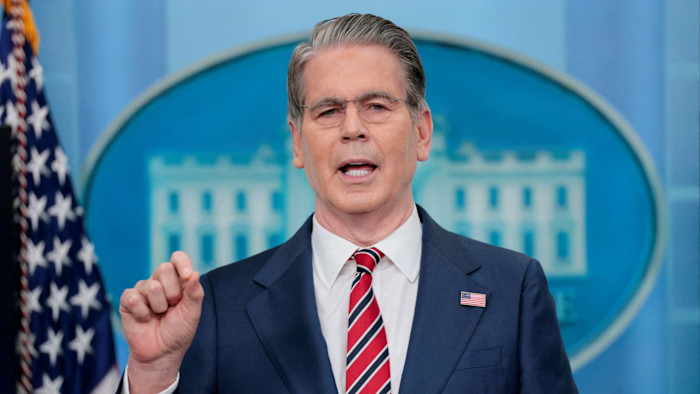
Scott Bessent’s ability to provide dollar swap lines for allies in Asia and the Gulf could be constrained by the limited firepower of the Treasury facility at his command, analysts have warned.
While the Federal Reserve has no formal ceiling on the amount of dollars it can provide to foreign central banks, the US Treasury’s own capacity to do so is far more limited.
The Treasury secretary said on Wednesday that several countries in Asia and the Gulf, including the United Arab Emirates, had asked him for swap lines as a backstop to help support renewed demand for the US currency — driven by high oil prices — since the US and Israel attacked Iran.
A person familiar with the matter said nothing concrete had been decided on offering the support. But if the US Treasury did announce swap lines, those facilities would almost certainly come from its $219bn Exchange Stabilisation Fund, or ESF.
“There is a great irony in the suggestion that the UAE, with reserves of close to $300bn and a reported $2tn in their sovereign wealth funds, would need to borrow from the ESF,” said Brad Setser, a senior fellow at the Council on Foreign Relations. “It’s a much smaller pool of money.”
Shahab Jalinoos, head of G10 foreign exchange strategy at UBS, said: “This may be more of a political signal than because of a cash crunch . . . It would be a vote of confidence in the relationship between the US and the UAE and other Gulf countries.”
The ESF is primarily used for limited interventions in foreign economies that have run out of reserves or have maxed out IMF loans. The US Treasury most recently used it last year to provide a $20bn short-term bailout to Argentina to avert a run on the peso ahead of elections.
That contrasts sharply with the Fed, whose swap lines, which allow countries to exchange their currencies for US dollars, are potentially unlimited as the central bank holds the monopoly on issuing the US currency.
However, officials with knowledge of the matter said the US central bank had not been formally consulted on Bessent’s conversations with Gulf and Asian officials. A spokesperson for the Fed declined to comment.
The Fed’s swap lines have a different function: the central bank views them as a means to address short-term dollar funding needs — which officials say are not currently present — and would be reluctant to use them to help countries alleviate strains on their currencies.

Seth Carpenter, global chief economist at Morgan Stanley, said the US Treasury’s willingness to provide swap lines for countries such as Argentina and potentially the UAE seemed to be driven by a “philosophical affinity” rather than “cleaning up the plumbing”, as with the Fed’s facilities.
Bessent’s comments came as countries seek to defend their currencies against a stronger dollar. Foreign central banks’ holdings of US Treasuries are hovering close to their lowest level since 2012, suggesting some reserve managers are selling off dollar assets to raise funds to intervene in foreign-exchange markets.
Many countries in the Gulf and Asia maintain official or de facto dollar pegs. Several countries in the Gulf region have also announced big spending commitments in US industries, requiring yet more dollars.
Mahmood Pradhan, a former IMF official who is now a non-resident fellow at the Bruegel think-tank, said: “Gulf countries may be looking at a weaker outlook for inflows, because of disruptions to exports and lower capital inflows.

“A precautionary buffer, especially because of their currency pegs, would be reassuring for markets. In the past, the Fed has preferred to restrict their swap lines to only the major currencies, which may explain why Gulf countries would approach the Treasury.”
In Argentina’s case, its Treasury swap line made up to $20bn available but the South American country ultimately only borrowed $2.5bn for two months to support the peso, which stabilised after a key election.
While the facility was controversial with some US lawmakers, White House economic adviser Kevin Hassett said earlier this week that rather than costing US taxpayers, it had “made money”.
Handing the UAE an ESF swap line like Argentina’s would be very different from a Fed swap line, said Lev Menand, associate professor at Columbia Law School and author of The Fed Unbound: Central Banking in a Time of Crisis.
“The latter helps you run a dollar-based financial system without a lot of dollar reserves. The former was basically a loan to the [Argentine] government,” he said.
The UAE was frustrated by the leak of the fact that it had discussed a swap with the US Treasury and by inferences that this suggested a liquidity squeeze in the Gulf state.
Yousef al-Otaiba, the UAE’s ambassador to Washington, said “any suggestion that the UAE requires external financial backing misreads the facts”.
“The UAE is one of the world’s most financially resilient economies, underpinned by more than $2tn in sovereign investment assets,” he said on X.
Investors said the swap line requests were likely to be a contingency move against further economic fallout from the Middle East conflict.
“They want an emergency dollar backstop in case Asian dollar funding markets or Gulf dollar revenues dry up,” said Viktor Szabo, investment director at Aberdeen, describing it as “more of a confidence measure rather than willingness to use such lines”.
“It might also reduce the need for them to fire-sell dollar assets in case they require more dollar liquidity,” Szabo added.
Mark Sobel, senior adviser in economics at the Center for Strategic and International Studies and a former official at the IMF and US Treasury department, said: “The global dollar network is not facing massive stress as it did during the [global financial crisis] and pandemic. Gulf states often have massive dollar holdings and do not likely face liquidity stress.”
The only strong argument for providing countries such as the UAE with swap lines would be to avoid financial market disruption, said Stephen Paduano, a lecturer at Oxford university and former US Treasury adviser.
The UAE, he said, “has more than enough US equities and Treasuries to meet its needs. But selling those could cause a stock market rout and impact Treasury market functioning.”
Gulf states boast some of the world’s largest and most active sovereign wealth funds to draw on, collectively managing more than $5tn. These include the Abu Dhabi Investment Authority, Saudi Arabia’s Public Investment Fund, the Qatar Investment Authority and the Kuwait Investment Authority.
Swap lines have been a crucial backbone of the global dollar system, especially in the aftermath of the 2008 financial crisis. The Fed still maintains lines with big global central banks in the Eurozone, the UK, Switzerland, Japan and Canada.
When foreign central banks are given special dollar liquidity privileges in the form of swap lines, the US typically holds the foreign currency. In return, the foreign central bank avoids financial firms under their jurisdiction selling off assets or failing to meet their dollar obligations. That prevents a risk of contagion and global panic.
The Fed also has a backstop in place — the so-called Foreign and International Monetary Authorities, or FIMA, repo facility — that enables foreign countries to use their holdings of US Treasury securities to access short-term dollar funding, without having to sell their Treasury holdings.
Sobel said he was unsure whether the US Treasury would proceed to offer swaps to Gulf states. He added: “The reason to do so would be to send a political signal of support and a message about reinforcing dollar dominance.”
The US Treasury did not respond to a request for comment.
Additional reporting by Ian Smith, Joseph Cotterill and Andrew England in London


