Unlock the Editor’s Digest for free
Roula Khalaf, Editor of the FT, selects her favourite stories in this weekly newsletter.
Germany plans to award a contract for kamikaze drones to defence start-ups Helsing and Stark as it seeks to boost defences against Russia as well as fuel competition in the defence sector.
The two German start-ups and the country’s largest contractor Rheinmetall will receive a share of the contract, worth close to €300mn each, according to three people familiar with the matter.
Formal agreements have yet to be signed, but if the contracts are approved by the German parliament’s budget committee, they are likely to be the biggest deals won by the two young start-ups.
Under the agreement, the three companies will agree to provide up to 12,000 drones, according to one of the people familiar with the discussions, although only part of that number will be delivered up front.
They are expected to be supplied to a new German brigade stationed in Lithuania with the aim of defending Nato’s eastern flank against Russia.
Officials hope that dividing the tender between the three companies will encourage innovation, according to people familiar with the situation.
“They’re doing it to keep the competition alive and make sure they get the best system,” one of the people said.
The deal comes as European nations seek to beef up their capacity for drone warfare, both by embracing defensive technologies to protect against drone incursions and also offensive drones for striking enemy targets.
Investment in Europe’s defence technology start-ups has surged since Russia’s full-scale invasion of Ukraine, with venture capital firms piling into military businesses.
Helsing, backed by Spotify founder Daniel Ek, is Europe’s most valuable defence start-up with a valuation of €12bn.
Over the past year it has announced plans to supply 6,000 strike drones for Ukraine, bought German aircraft manufacturer Grob and unveiled plans to manufacture underwater surveillance systems in the UK.
Stark, founded just 15 months ago, is backed by investors including US tech billionaire Peter Thiel and Silicon Valley’s Sequoia Capital. The start-up has a team in Ukraine engaged in testing and development and in July it announced it would open a factory in the English town of Swindon.
Plans to award part of the contract to the tanks and artillery giant Rheinmetall, which has already won tens of billions of euros of government contracts, took some defence executives by surprise.
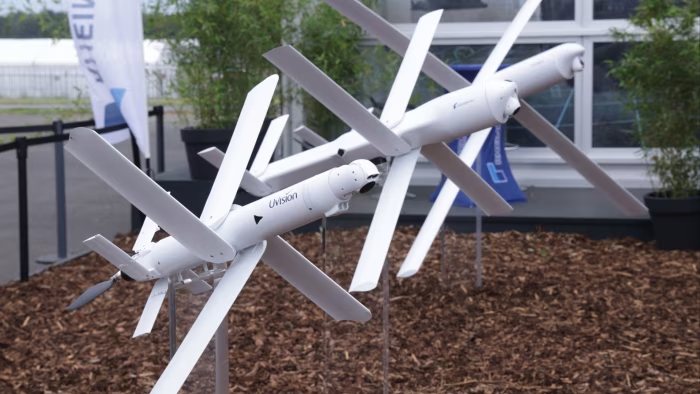
Though the company has partnerships with the US drone-maker Anduril and the Israeli company UVision, until recently it did not have its own in-house armed drone.
The Düsseldorf-based Rheinmetall offered to supply the German military with an armed drone called the FV-014, which it unveiled publicly in September, according to two people familiar with the matter. Also known as Raider, the FV-014 can carry a 5kg payload and has a range of 100km, according to the company.
Stark will provide its Virtus armed drone and Helsing its HX-2.
Rheinmetall has “managed to find a way in,” said one German defence industry executive.
Helsing, Stark, Rheinmetall and the German procurement office all declined to comment.