Unlock the Editor’s Digest for free
Roula Khalaf, Editor of the FT, selects her favourite stories in this weekly newsletter.
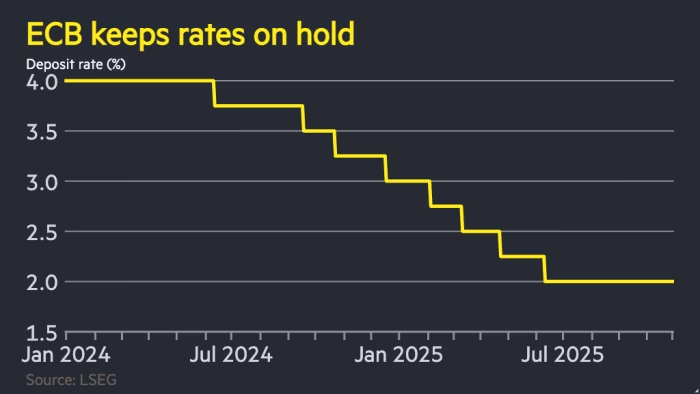
The European Central Bank has left its benchmark interest rate unchanged at 2 per cent for the third consecutive meeting, as data showed tentative growth in the Eurozone.
Thursday’s decision was in line with economists’ expectations and comes after ECB president Christine Lagarde repeatedly said that monetary policy in the currency area was “in a good place”.
“The economy has continued to grow despite the challenging global environment,” the ECB said in a statement, adding that the labour market was “robust” and private sector balance sheets “solid”. It also described the outlook for inflation as “broadly unchanged”.
Data from Eurostat on Thursday showed that Eurozone GDP surpassed expectations to grow 0.2 per cent in the third quarter, after French output expanded at the fastest pace since 2023. However, the German economy continued a years-long run of lacklustre growth.
Traders’ expectations of future interest rate cuts were broadly unchanged following the rate decision, with swaps markets estimating a roughly 40 per cent probability of another quarter-point rate reduction by June 2026.
Karsten Junius, chief economist at J Safra Sarasin, said it was “surprising” that the ECB’s monetary policy statement did not mention “existing downside risks to inflation”.
He added that the lack of “dovish signals” suggested that “a rate cut in December had become less likely”, noting that the central bank’s own forecast pointed to an inflation rate of less than 2 per cent next year.
The ECB announcement came a day after the US Federal Reserve cut US interest rates by a quarter point but warned that a further reduction this year was not a “foregone conclusion”.
Annual inflation in the Eurozone, which climbed to 2.2 per cent in September, is expected to have fallen slightly to 2.1 per cent this month, according to analysts polled by LSEG. A flash inflation estimate for October will be released by Eurostat on Friday.
The ECB’s previous rate cuts, which began in June last year, have pushed borrowing costs to their lowest level since December 2022.
The euro was broadly flat against the dollar at $1.156 after the widely expected decision, and was 0.4 per cent lower on the day.
“The euro’s weakness, despite encouraging GDP data, is mainly driven by the Fed’s hawkish turn,” said Dimitris Valatsas, chief economist at Aurora Macro Strategies.