Unlock the Editor’s Digest for free
Roula Khalaf, Editor of the FT, selects her favourite stories in this weekly newsletter.
The French prime minister has pledged to suspend President Emmanuel Macron’s unpopular pensions reform in a last-ditch attempt to secure parliamentary support for the 2026 budget and save his premiership.
In a major breakthrough for the left and a U-turn on Macron’s flagship economic policy, Sébastien Lecornu said on Tuesday that he would suspend plans to raise the retirement age to 64 until 2027, when presidential elections are due. But parties would have to agree on other savings to keep next year’s deficit at under 5 per cent of national output, he added.
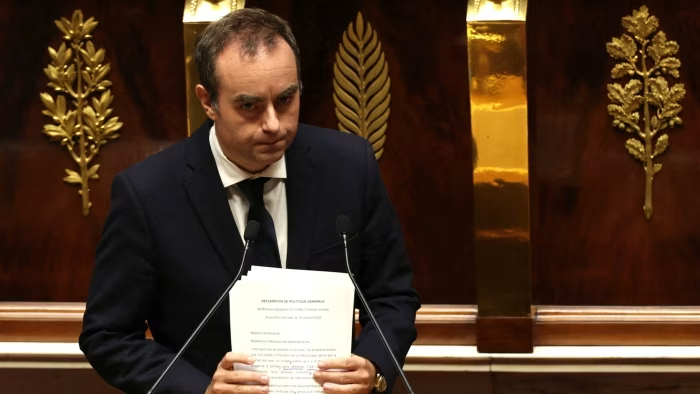
“Is the government ready for a new debate on the pensions reform? The answer is yes,” Lecornu told lawmakers in his first speech to parliament, in which he also promised additional taxes on companies and a new approach to hold parliamentary debates on all government proposals.
The prime minister, who resigned last week only to be reappointed days later by Macron as France’s political crisis spiralled, has struggled to meet the demands of various factions in the hung parliament in return for them backing his proposals on how to cut France’s high public deficit next year.
The Socialist party, on whom Lecornu depends for his survival, had urged the government to freeze the controversial 2023 reform that gradually raises the retirement age by two years to 64. The suspension would cost €400mn in 2026 and €1.8bn in 2027, Lecornu said.
France’s budget has become a central battleground in the country’s political crisis, crystallising arguments in a hung National Assembly.
Without an agreement, France can avoid a US-style shutdown and roll this year’s budget into 2026, but the disputes have unnerved markets already concerned by the gaping deficit and caused three French governments to fall in the past year.
Lecornu’s commitments on pensions were applauded by socialist MPs, while leading conservative lawmaker Laurent Wauquiez said that the country needs a budget before the end of the year, opening a narrow path towards his government surviving.
The premier outlined a €30bn fiscal package of spending cuts and tax rises, designed to take the deficit to 4.7 per cent of national output in 2026 from 5.4 per cent this year. The prime minister said everything was up for debate, however, and the target could be eased, although he urged parties to agree to keep the deficit under 5 per cent.
While stopping short of announcing a sweeping wealth tax, which entrepreneurs had raised concerns about, Lecornu said there would be an “exceptional contribution from large fortunes” and levies on holding companies that can sometimes escape taxes on dividends.
The government is set to extend a measure to raise corporate taxes, which had already been used in 2024 and 2025 to balance the budget but was supposed to be temporary — a move likely to alienate big French businesses.
“There will be tax cuts for small and medium businesses and there will be targeted and exceptional tax rises for some very large businesses . . . to better share the efforts among contributors”, he said.
Throughout his address to parliament, Lecornu also made another concession to the Socialist party. Repeating a pledge made prior to the collapse of his first government, he said he would not use the 49.3 constitutional clause that enables the government to force through legislation without a parliamentary vote.
“The government will propose, we will debate and you will vote,” he repeated on several occasions, raising the prospect of difficult debates on all elements of government policy.