

Unlock the White House Watch newsletter for free
Your guide to what Trump’s second term means for Washington, business and the world
A top Federal Reserve official has warned against launching a series of rate cuts, saying a sharp slowdown in the jobs market is not a sign that a recession is looming.
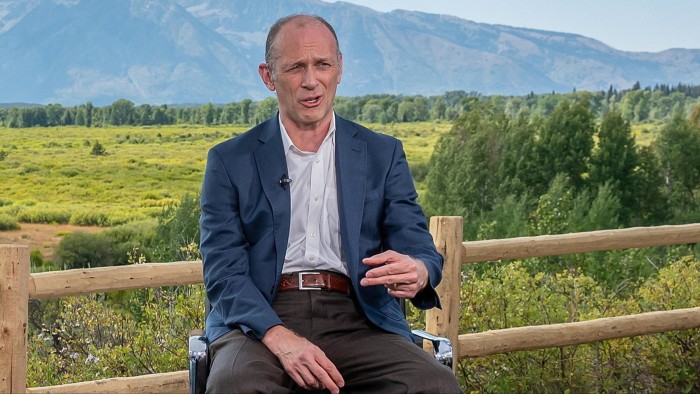
Austan Goolsbee backed the quarter-point reduction to US borrowing costs at last week’s Federal Open Market Committee meeting. But the Chicago Fed president told the Financial Times that he could be less willing to support further cuts at forthcoming policy votes.
“I’m uncomfortable with overly frontloading a lot of rate cuts on the presumption that [inflation] will probably just be transitory and go away,” he said, adding that many midwest businesses are still concerned that inflation was not under control.
The Fed lowered its main rate to a range of 4 to 4.25 per cent — the first cut this year — after figures from the Bureau of Labor Statistics showed a sharp slowdown in hiring this summer.
Fed chair Jay Powell has also expressed growing conviction that US President Donald Trump’s tariffs will cause a one-time rise in prices rather than a more worrying persistent increase in inflation.
Goolsbee said new set of labour statistics produced by the Chicago Fed — which collate several economic reports to produce real-time data — showed only a “mild” cooling and did not suggest the US economy was in the throes of a sharp slowdown.
“We’ve still got a mostly steady and solid jobs market,” Goolsbee said, adding that the low 4.3 per cent unemployment rate and labour market turnovers painted a more positive picture than non-farm payrolls data that were influenced by Trump’s clampdown on immigration.
He added that while the impact of tariffs on inflation would probably be shortlived, inflation had been over the Fed’s 2 per cent target for four and a half years and was “now heading the wrong way”.
Goolsbee said he supported last week’s cut because of signs that Trump’s trade war was proving less inflationary than many economists had feared — in part because many of the US’s main trade partners have shown little interest in retaliating against the White House.
Last week’s rate cut came amid fierce pressure from the White House to lower borrowing costs, with the president labelling Powell a “moron” for keeping rates on hold since December.
Trump’s attempts to fire Fed governor Lisa Cook and his claims that he will soon have a “majority” on the central bank’s Washington board have stoked concerns that he will seek to remove one or more of the dozen regional Fed presidents.
Goolsbee played down those fears, saying that in the 112-year history of the Fed “reappointments have always been based on the merits”.
“People take their jobs really seriously at the Fed,” he said, adding that monetary policy independence was “critically important . . . if you want to stop inflation from coming back”.
Markets pricing suggests investors expect another two quarter-point rate cuts from the Fed this year. The central bank’s latest economic projections show that a slim majority of Fed officials back two or more additional cuts this year.
Fed governor Michelle Bowman on Tuesday outlined her case for more action, saying she was “concerned that the labour market could enter into a precarious phase”, with a shock morphing “into a sudden and significant deterioration”.
“Cutting the policy rate 25 basis points and signalling additional adjustments at upcoming meetings should allow longer-term interest rates to remain materially lower than earlier this year and help to support the economy,” Bowman said.
Goolsbee said Trump’s trade policies were to blame for his reluctance to lower borrowing costs more aggressively.
“Before we started throwing a bunch of stagflationary dirt in the air in April, I was in a spot where I thought we could commence the march down to something like neutral,” he said. “Which is a fair bit below where [rates] are today”.
He also said Trump’s plans, unveiled on Friday, to charge a $100,000 application fee for H-1B visas aimed at highly skilled foreign workers could end up weakening US growth.
“It obviously depends a lot on the details. [There are] a bunch of fundamental questions,” Goolsbee said. “Your worry would be entrepreneurship, innovation. Are we going to come back after five years and find that the productivity boon ended?”
He added: “Investing in science and attracting scientific talent is, in the economic literature, strongly correlated with productivity growth.”
A transcript, edited for brevity and clarity, is available from the Financial Times’ Monetary Policy Radar service here.


