Unlock the Editor’s Digest for free
Roula Khalaf, Editor of the FT, selects her favourite stories in this weekly newsletter.
Google’s cloud boss says that a pair of new chips and rapid advances at its DeepMind AI lab will help it close the gap with Microsoft and Amazon in the fiercely competitive cloud computing market.
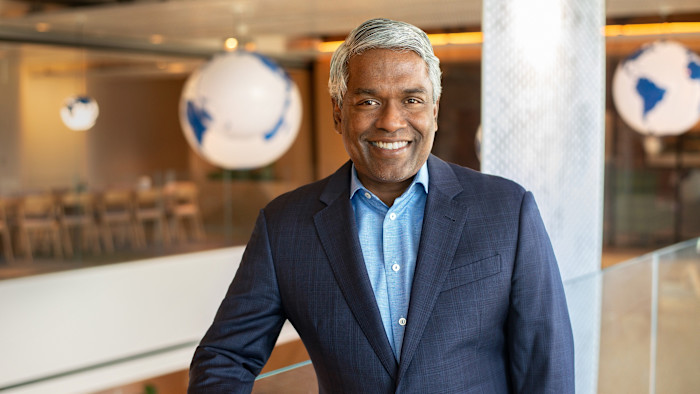
Thomas Kurian said that after a slow start in AI and entering the cloud business late, Google’s “full-stack” AI strategy — which includes building chips, data centres, foundation models and products in-house — was starting to pay off.
“We’re not just a hyperscaler reselling other people’s technology. Our differentiation comes down to the fact that we own the IP, the model and the chips are ours,” Kurian said in an interview.
“For every dollar of revenue, we’re not shipping 80 per cent of it to either a model or chip provider, which allows us to invest more,” he added.
Eight years after joining Alphabet from Oracle, Kurian has grown its cloud market share from 7 to 14 per cent — cementing his position as a contender to be Google’s next leader.
But Google Cloud remains a distant third to Amazon Web Services and Microsoft’s Azure in the $418bn cloud-computing market. Alphabet has also been criticised for allowing OpenAI and Anthropic’s chatbots and coding assistants to leapfrog its own AI products.
AI is now helping Google Cloud to grow faster than its rivals; it reported a 48 per cent jump in revenue in the final quarter of 2025 and is on track to generate more than $70bn this year, up from $43bn in 2024.
Google believes its TPUs and Gemini models are far ahead of Amazon’s Trainium chips and Nova AI system as well as Microsoft’s Maia processors and MAI models. This makes the search giant less dependent on partnerships with Anthropic and OpenAI or on Nvidia’s expensive GPU chips.
Kurian said that Google’s 12-year investment in DeepMind allowed it to continually improve its proprietary chips and deliver consumer and enterprise AI products at a lower cost with better margins.
Google unveiled two new chips this week at a splashy event in Las Vegas, the eighth generation of its TPUs, or Tensor Processing Units. One specialises in training AI models, while the other has more memory to run AI systems faster, known as inference.
“You need a large lab in-house to really build an amazing chip [and] I don’t think the other players are building their own models, of any quality at least,” Kurian said. Only Nvidia currently rivalled Google’s combination of AI hardware and integrated chip software, he added.
Google’s emergence as a competitor to Nvidia has strained the relationship between the two companies, even as Alphabet remains one of its biggest GPU customers.
A report from Epoch AI estimates that Google controls about a quarter of global AI computing power, about 3.8mn TPUs and 1.3mn GPUs. Microsoft is second with 3.2mn Nvidia GPUs.
In a recent podcast, Nvidia chief executive Jensen Huang criticised Google for not submitting its AI chips to independent tests and cast doubt on their performance and efficiency claims.
He added that “100 per cent” of demand came from Anthropic and without the start-up “why would there be any TPU growth at all?”
Kurian responded that nine of the top 10 AI labs used TPUs, including ex-OpenAI executive Mira Murati’s Thinking Machines. OpenAI cannot because of an exclusivity deal with Microsoft.
“They have a choice of what to buy. If we were not competitive in performance, in price, in quality, they would choose not to do so,” he said.
Anthropic on Friday struck a deal under which it will buy more of Google’s chips. Google agreed to invest up to $40bn in the start-up and provide 5GW of computing capacity over five years, worth more than $200bn.
Google is also spending heavily on its in-house AI efforts, with capital expenditures forecast to rise to $185bn this year. Kurian argues the vast sums are justified by customer demand and strong revenues.
He said OpenAI and Anthropic face a more difficult financial path, which could also imperil Big Tech groups that rely on them. Both start-ups are losing tens of billions a year as they race to secure computing power to train and run their models.
“Those AI providers depend on private capital markets, which are reaching a saturation point,” he added. “If you’re going to go public, you can’t be lossmaking forever. And if you stay private, you cannot raise venture money forever.”
This year OpenAI and Anthropic raised more than $150bn in two of the largest private fundraisings in history as they prepared for IPOs. Dozens more start-ups have raised multibillion-dollar sums.
“Over the next year to two you will see some shakeout in the market,” Kurian said. Whether “particular providers are going to make it or not largely comes down to the economics”.