

To submit a letter to the editor, click here.
URBANA — The Illinois Policy Institute reported in March 2025 that Champaign County was one of the state’s fastest-growing counties in 2024, citing data from the U.S. Census Bureau.
However, local contractors said that when it comes to hot-mix asphalt bid out to private contractors by the Illinois Department of Transportation for use on state roads, District 5, which includes Champaign County, has seen a major drop over the past two years — about 500,000 tons in 2024, 300,000 in 2025 and less than 50,000 in 2026.
Additionally, Renew Illinois Roads, a site created by the Downstate Infrastructure Awareness and Advancement Fund, stated that one-third of all roads in the Chicago area are graded as fair or poor, compared with nearly 45 percent downstate.
“Yes, we need money for roads everywhere, but hey, downstate roads are in worse condition than Chicago,” said Roger Driskell, executive director of the Associated General Contractors of Illinois.
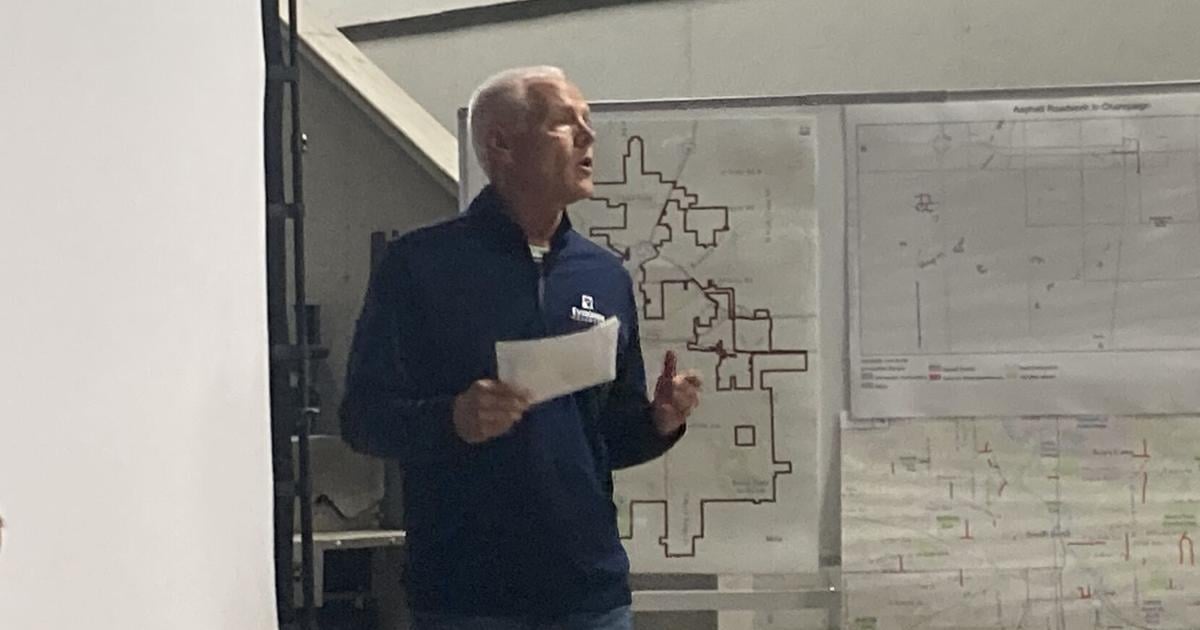
Evergreen Roadworks (formerly the Champaign Asphalt Company) hosted a meeting of road contractors, union leaders and elected officials Friday morning at its Anthony Drive headquarters to discuss “lack of funding and lack of work in road construction” in District 5 and other downstate areas.
“Today is the state letting day, and there is an inordinate number of contractors and suppliers and subcontractors here today. And it speaks to the lack of work that we’re getting to bid on,” said Evergreen President Joe Lamb.
State Rep. Brandun Schweizer, R-Danville, and Champaign Mayor Deb Feinen were among those in attendance.
The event included discussion of the impacts of the Northern Illinois Transit Authority Act, which Gov. J.B. Pritzker signed into law in December.
The governor’s office said that, among other things, the law:
- Creates the new agency to replace the Regional Transportation Authority and oversee the Chicago Transit Authority, Metra and Pace.
- Provides $1.5 billion annually to “stabilize transit systems across Illinois, including downstate operations.”
- Diverts about $860 million annually from the motor-fuel sales tax — which would otherwise go to the general revenue fund or the road fund — with 85 percent of the diverted funds going to the new agency and 15 percent to downstate transit.
- Diverts interest from the road fund and state construction account fund to transit capital, with 90 percent going to northeastern Illinois and 10 percent to downstate. This is expected to provide about $200 million in the first year, with annual amounts decreasing “as balances are spent down.”
Kevin Burke III, executive vice president of the Illinois Asphalt Pavement Association, said while local governments’ distributions do not come from the road fund or the state construction account, the diversions from these accounts will have an impact on IDOT projects.
However, the governor’s budget address did include $500 million for downstate transportation, Burke added. It’s his opinion that if these funds are included in the budget, they should be distributed to local governments through some kind of formula.
“If we use the federal distribution formula that kind of splits money out between the urban areas and the rural areas, rough calculation … we’d get about $5 million extra for the year” in Champaign County, Burke said. “Which is, I think we get about $1.2 million in federal funds in a given portion. So you’re talking about a 4x, 5x multiplier.”
Still, he noted that this would be one-time funding.
“We need funding that we can count on so that we can make those investments in the equipment, make the investment in our people,” Burke said.
“I think it’s vital that downstate speaks up about what’s going on,” Lamb said.
Additionally, John Peisker, vice president of special projects at Evergreen, shared a website that industry professionals can use to contact their U.S. senators and representatives to ask for “a robust, multi-year surface transportation reauthorization bill that sustains and increases highway funding beyond current authorization levels.”
“This is something that we can do,” Peisker said, noting that if the reauthorization bill isn’t passed, there won’t be a federal match to meet local funds.
The site — materialsgrassroots.com/engage — was put together by the National Stone, Sand & Gravel Association, the National Asphalt Pavement Association, the National Ready Mixed Concrete Association and the American Cement Association.
“By passing this critical reauthorization with meaningful funding increases to keep pace with inflation, rising costs and growing needs, Congress can prevent project delays, protect our jobs, strengthen supply chains and continue delivering safer, more efficient infrastructure that grows our economy and supports working families nationwide,” stakeholders wrote.
Feinen agreed that continued advocacy is important.
“We really can’t accomplish big-scale things without federal and state matching funds,” she said.